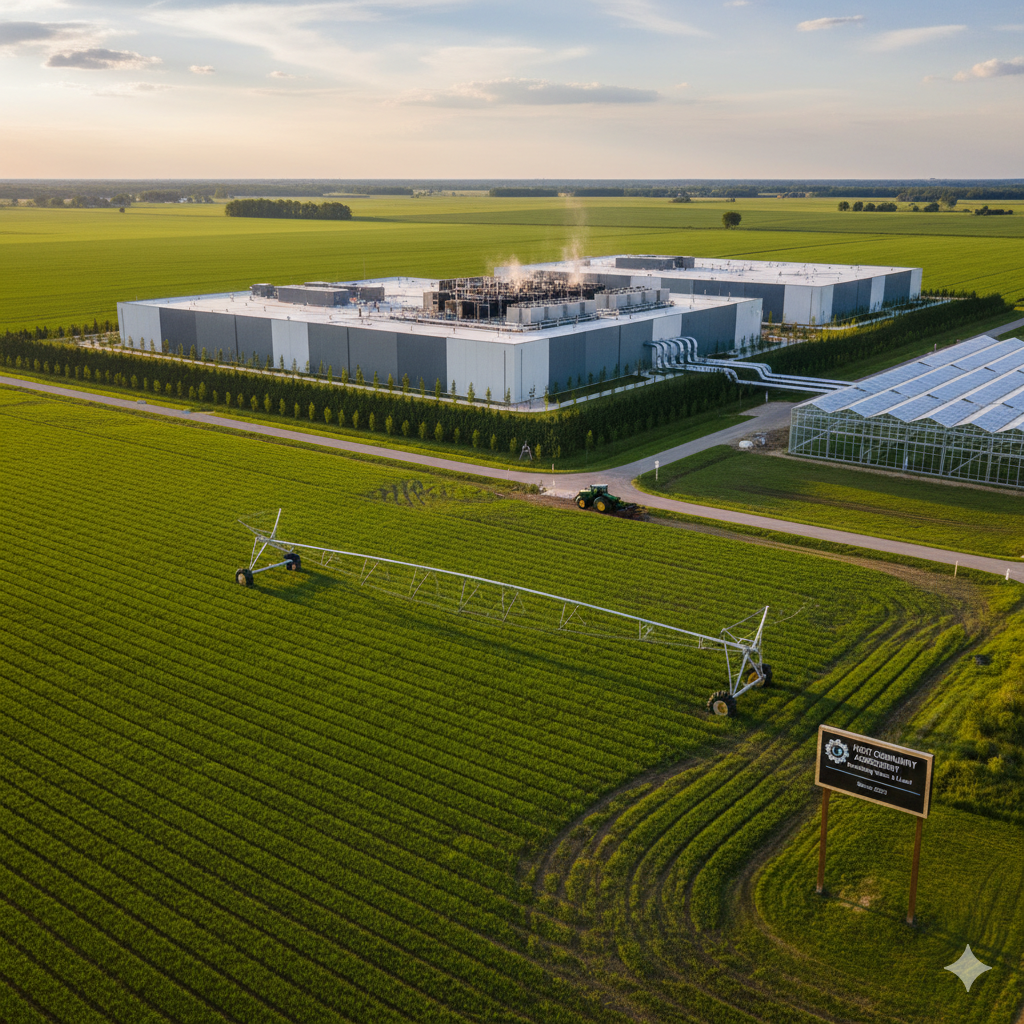
Living next to a large computer data center presents both potential pros and cons, primarily related to its significant environmental demands for water and electricity, and its potential to affect local air quality and create noise pollution.
💻 Pros and Cons of Living Near a Data Center
👍 Pros (Potential Local Benefits)
- Economic Growth: Data centers can bring investment and potentially a small number of high-skill jobs (mostly during construction and operation) to the immediate area.
- Improved Infrastructure: Their presence sometimes leads to upgrades in local power and internet infrastructure, which can benefit the wider community.
👎 Cons (Potential Community Issues) - Noise Pollution: Cooling systems and large industrial fans can generate a significant, continuous humming noise. Additionally, the periodic testing of backup diesel generators can create loud, temporary noise and exhaust.
- Air Pollution: Backup generators, typically run on diesel fuel, emit pollutants like nitrogen oxides (\text{NO}_x) and particulate matter (\text{PM}) during testing or power outages, which can negatively affect local air quality.
- Visual Impact: Large, windowless buildings can be an eyesore and affect scenic views.
- Property Value: While not universal, some residents have concerns about a potential decrease in property values due to the other negative impacts.
💧 Environmental Impact: Water Supply
Data centers require vast amounts of water primarily for cooling the servers and IT equipment, which generate intense heat. - Water Consumption: Data centers use millions of gallons of water annually. A medium-sized center can consume as much water as thousands of households.
- This consumption can strain local water resources, especially in drought-prone areas or communities with limited water supply.
- Water Cycle Impact: A significant portion of the water used for cooling is lost to the environment through evaporation in cooling towers. This water loss is effectively removed from the local water cycle in the short term, which is a concern for water-stressed regions.
⚡ Environmental Impact: Electrical Supply
Data centers are enormous consumers of electricity, requiring constant power for their servers and cooling systems. - Strain on the Grid: The high and continuous demand for electricity can strain the local and regional power grids.
- Increased Emissions: If the electricity supplied to the data center is generated using fossil fuels (like coal, oil, or natural gas), the center indirectly contributes to greenhouse gas (\text{CO}_2) emissions and other pollutants at the power plant, contributing to climate change and air pollution.
- Higher Costs: The increased energy demand can, in some cases, put upward pressure on electricity costs for all local consumers.
🧍 Impact on the Human Body
The most significant direct impacts on the human body stem from the center’s secondary effects: - Air Quality and Respiratory Health: Emissions from diesel backup generators introduce air pollutants like fine particulate matter (\text{PM}_{2.5}) and \text{NO}_x into the local environment. Frequent exposure to these pollutants is linked to respiratory issues (like asthma), heart and lung disease, and other health problems.
- Noise Pollution and Stress: Chronic exposure to the continuous, persistent noise from cooling systems can lead to sleep disturbance, headaches, elevated stress hormone levels, hypertension, and anxiety, and may pose an increased risk for cardiovascular issues.
- Electromagnetic Fields (EMFs): Data centers produce EMFs, but the levels generated are generally considered to be within safety guidelines and have not been conclusively linked to significant health risks for nearby residents.
Would you like to explore information on mitigation strategies that data centers can use to reduce their environmental and community impacts?
That’s an excellent follow-up question. Data centers are increasingly adopting strategies to mitigate their environmental and community impacts. These solutions focus on efficiency, resource conservation, and innovative system design.
💧 Mitigating Water Consumption
The primary goal is to shift away from water-intensive evaporative cooling, especially in water-stressed regions.
- Closed-Loop Liquid Cooling: Systems like direct-to-chip and immersion cooling (submerging servers in a non-conductive fluid) circulate a small amount of liquid in a sealed system. This drastically reduces or eliminates the need for water evaporation, making the water usage virtually zero for cooling.
- Air-Cooled (Dry Cooling) Systems: These use outside air or mechanical cooling without water evaporation. While they can consume more electricity than evaporative cooling, they are often prioritized in regions where water scarcity is the greater concern.
- Use of Non-Potable Water: Some data centers use reclaimed water, gray water, or stormwater runoff for their cooling systems instead of drinking-quality (potable) municipal water.
- Water Recycling and Reuse: Implementing advanced filtration to reuse the water that circulates in cooling towers multiple times before it needs replenishment.
⚡ Mitigating Electrical Strain and Emissions
Strategies focus on reducing overall energy demand and sourcing cleaner power. - Renewable Energy Sources: Companies commit to purchasing power from or directly building solar and wind farms to offset their electricity consumption, moving toward a goal of net-zero carbon emissions.
- Improved Energy Efficiency (PUE): Data centers constantly work to improve their Power Usage Effectiveness (PUE) score (the ratio of total facility power to IT equipment power). Lower PUE means less energy is wasted on non-computing needs like cooling and lighting.
- Waste Heat Reuse (District Heating): Instead of venting heat into the atmosphere, the excess heat from servers is captured and transferred to a local district heating system. This recovered energy can be used to heat nearby homes, businesses, or even greenhouses, turning the waste product into a valuable community asset.
👂 Mitigating Noise and Air Pollution
These measures address the most immediate impacts on nearby residents.
| Impact | Mitigation Strategies |
|—|—|
| Noise Pollution | Acoustic Barriers: Installing large, dense soundproof walls or fences around the perimeter. Strategic Placement: Positioning high-noise equipment (generators, chillers) away from residential boundaries, sometimes even underground. Acoustic Treatment: Lining equipment rooms and air ducts with sound-absorbing materials. Quieter Cooling: Adopting liquid cooling, which eliminates the loud fans typically required for air-based systems. |
| Air Pollution | Cleaner Backup Power: Moving toward large-scale battery backup or exploring cleaner fuel sources for generators instead of diesel. Emissions Capture/Filtration: Deploying technology to capture and filter exhaust from diesel generators to reduce \text{NO}_x and particulate matter. |
| Visual/Aesthetic | Zoning and Design: Working with local governments to ensure the building design is compatible with the surrounding area and using natural landscaping (trees, berms) to screen the facility. |
Would you like to learn about the regulations or standards that guide data center sustainability and location decisions?
Navigating the construction and operation of data centers involves a complex web of standards, regulations, and industry-led best practices at the international, national, and local levels.
Here is an overview of the key frameworks that govern data center sustainability and community impact:
🏛️ Local and State Regulations (Direct Community Impact)
The most direct protection for residents comes from local and state-level laws, particularly those related to permitting.
| Area of Regulation | Mechanism and Impact |
|---|---|
| Zoning & Permitting | Local Zoning Ordinances determine where data centers can be built (e.g., industrial zones only). The permitting process often requires detailed infrastructure assessments covering power, water, and environmental impact. |
| Noise Pollution | Local Noise Ordinances set maximum decibel (dB) levels, often measured at the property line or the nearest residential structure. Developers must prove that the combined noise from cooling fans and generators will stay below these thresholds 24/7. |
| Air Quality | Data centers must comply with State and Federal Clean Air Act requirements, particularly concerning emergency diesel generators. They typically need an Air Permit which limits the hours generators can run and caps the total annual emissions (\text{NO}_x, \text{PM}, etc.). |
| Water Usage | Increasingly, states and local governments are imposing requirements on large water users. This may include mandating closed-loop cooling systems in water-stressed areas or requiring detailed Water Stewardship Plans that commit to recycling or using non-potable sources. |
| 🌐 International and Industry Standards (Sustainability & Efficiency) | |
| These non-binding certifications and metrics are crucial for benchmarking performance and guiding design. |
- Energy Efficiency and Management
- ISO 50001 (Energy Management System): An internationally recognized standard that provides a framework for organizations to develop, implement, and maintain a system for improving energy efficiency and consumption.
- ENERGY STAR: A U.S. voluntary program that certifies data centers (the building and infrastructure) that demonstrate high energy efficiency, helping to reduce greenhouse gas emissions.
- PUE (Power Usage Effectiveness): The universally accepted industry metric for energy efficiency. A PUE of 1.0 is ideal (all power goes to IT equipment); most modern centers aim for a score between 1.1 and 1.5.
- Water Conservation
- WUE (Water Usage Effectiveness): The industry metric that tracks water consumption. It is calculated as the ratio of annual water use (liters) to annual IT energy consumption (kWh). A lower WUE is better, with a score of 0 indicating no evaporative water use for cooling.
- “Water Positive” Commitments: Many major tech companies have set goals to replenish more water than they consume by 2030, which involves direct investment in local watershed restoration projects.
- Green Building Certification
- LEED (Leadership in Energy and Environmental Design): A popular green building certification that assesses a structure across multiple sustainability metrics, including energy, water, materials, and site development. A data center can earn LEED certification (Certified, Silver, Gold, or Platinum) to demonstrate its environmental credentials.
Evolving Regulatory Landscape
The speed of data center expansion (driven by AI demand) is outpacing existing regulations. Governments are beginning to address this through: - New Legislation: Proposals like the U.S. Clean Cloud Act aim to mandate data collection on energy and water consumption.
- Heat Reuse Requirements: Some European and Asian countries are beginning to mandate or incentivize data centers to connect to district heating systems to reuse waste heat.
Would you like to review any specific data center projects or controversies related to these regulations and their community impact?
Yes, the rapid expansion of data centers has led to several high-profile controversies, often highlighting the tension between corporate demands for resources and the needs of local communities. These issues generally revolve around water use in arid regions and noise pollution in dense areas.
Here are some key examples of data center controversies and the community responses:
💧 Water Scarcity Conflicts (Arizona & New Mexico)
In the arid Southwest, water consumption is the central point of contention, leading to direct pushback from residents.
| Location | Company/Project | Core Community Concerns |
|---|---|---|
| Tucson, Arizona | “Project Blue” (Proposed Data Center) | Strain on Water Supply: Residents vehemently opposed the proposal because the data center would have become the top electricity and water user in an area facing persistent drought. The opposition, focused on protecting reclaimed and groundwater, was successful, leading the City Council to unanimously reject the project. |
| Los Lunas, New Mexico | Meta (Facebook) Data Center | Aquifer Depletion: Community groups like “Valencia Water Watch” protested the expansion, arguing that a desert is an unethical location for a facility that uses millions of gallons of water, regardless of efficiency claims. |
| New Mexico | “Project Jupiter” (Hyperscale Project) | Basic Human Needs vs. Corporate Use: Residents, who already struggle with arsenic contamination in their drinking water, fear the massive water draw for the data center will deplete the limited usable water left. Developers’ claims of “one-time” closed-loop water use are highly scrutinized. |
Key takeaway: Even when companies implement water-saving measures (like Meta’s use of closed-loop cooling and water restoration projects), the sheer scale of consumption and the moral argument of prioritizing corporate profit over basic community water needs in a desert remain a major source of conflict.
👂 Noise Pollution Crisis (Northern Virginia)
Northern Virginia—known as “Data Center Alley” for hosting the largest concentration of data centers globally—is the focal point for noise-related complaints.
Issue Details and Community Impact The “Eerie Hum” Residents near data centers in counties like Loudoun and Prince William report a loud, incessant, low-frequency humming noise from the industrial cooling fans. People describe the sound as a “loud drone,” a “propeller,” or a “freight train” that goes through walls and disrupts sleep, leading to anxiety and mental health stress. Regulatory Gaps Residents have found that local noise ordinances are often outdated and were designed for residential HVAC units, not massive industrial fans. Although some data centers have been found to regularly exceed noise limits, the regulatory system has been slow to enforce or revise its rules. Political Backlash Community opposition has become highly organized, forming coalitions (like the Data Center Reform Coalition) to push for new regulations, stricter zoning, and even successfully electing local council members who promised to block data center expansion. 📈 Evolving Corporate & Regulatory Response These controversies are forcing changes in both corporate behavior and government regulation:
- Technological Shift: Major operators like Microsoft are now announcing new data center designs that aim for “zero water for cooling” (achieved using highly efficient chip-level, closed-loop liquid cooling) to address the water crisis directly.
- Increased Scrutiny: Local governments that once eagerly sought the tax revenue from data centers are now pausing development (moratoriums) to study the full community and environmental impacts before approving new projects.
- Mandatory Disclosure: There is a growing legislative push to make data centers publicly disclose their precise water and energy consumption to increase transparency and accountability.
Would you be interested in a summary of the key metrics used to evaluate a data center’s impact (PUE and WUE) and the ideal targets for each?
Yes, to quantify their environmental efficiency and manage their public perception, data centers rely on two core metrics: Power Usage Effectiveness (PUE) and Water Usage Effectiveness (WUE).
⚡ 1. Power Usage Effectiveness (PUE)
PUE measures the energy efficiency of a data center by showing how much of the total power consumed is actually used for computing (the IT equipment) versus being used for necessary overhead (like cooling, lighting, and power delivery).
🔍 Formula
🎯 Ideal and Industry Target Scores
| PUE Score | Meaning and Context |
|---|---|
| 1.0 | The Ideal (Perfect Efficiency). This theoretical score means 100% of the power is used by the servers, with zero wasted on overhead. |
| 1.1 – 1.2 | Industry Best-in-Class. State-of-the-art data centers often target or achieve scores in this range, representing excellent modern efficiency. (e.g., Google reports a fleet average around 1.09). |
| 1.58 | Industry Average. This score (as of recent industry reports) means that for every 1 watt used for computing, 0.58 watts are used for facility overhead. |
Goal: The lower the PUE, the better. Lower PUE directly translates to less energy draw, which indirectly reduces the facility’s carbon footprint (unless 100% of power is from renewables).
💧 2. Water Usage Effectiveness (WUE)
WUE measures the water efficiency of a data center by tracking the amount of water used for cooling relative to the energy consumed by the IT equipment.
🔍 Formula
(Note: This is often reported in \text{L/kWh} or \text{m}^3\text{/MWh}.)
🎯 Ideal and Industry Target Scores
WUE Score (L/kWh) Meaning and Context 0.0 The Ideal (Zero Water Consumption). This score is achieved by data centers that use only air cooling or closed-loop liquid cooling without any evaporative processes. 0.2 – 0.5 Highly Efficient. Centers that use some water (e.g., for humidification or periodic evaporative cooling) but have optimized their systems significantly. 1.8 – 1.9 Industry Average. This score represents the typical water usage of older facilities or those relying heavily on traditional evaporative cooling systems. Goal: The lower the WUE, the better. Achieving a low WUE is especially critical in water-stressed regions, even though air-cooling systems that achieve a very low WUE may sometimes have a slightly higher PUE (known as the water-energy trade-off). Would you like to know more about the incentives that governments and utility companies offer to encourage data centers to meet these PUE and WUE targets?
Yes, governments and utility companies offer various financial and regulatory incentives to encourage data centers to meet high efficiency standards, specifically targeting low PUE and responsible WUE.
These incentives generally fall into three categories: Tax Benefits, Utility Programs, and Infrastructure Support.
💰 1. Tax Incentives (Government-Led)
Governments, especially at the state level, use the tax code to significantly reduce the cost of building and equipping highly efficient facilities.
- Sales and Use Tax Exemptions: This is the most common and powerful incentive. Many states waive sales tax on the purchase of expensive IT equipment (servers, networking gear) and critical infrastructure like high-efficiency cooling systems and Uninterruptible Power Supplies (UPS).
- Goal: Directly lower the financial barrier to equipping the data center, allowing more budget for high-PUE equipment.
- Property Tax Abatements: Local governments may offer substantial reductions or temporary exemptions on property taxes for facilities that commit to meeting specific investment thresholds and job creation targets.
- Income Tax Credits: Federal programs, such as those expanded by the Inflation Reduction Act (IRA) in the U.S., offer credits for using renewable energy sources (solar, wind) or investing in energy-efficient building design (e.g., the Section 179D deduction).
💡 2. Utility Programs and Rebates (Utility-Led)
Utility companies actively encourage energy efficiency to manage grid demand, offering direct financial rewards for equipment upgrades. - Direct Rebates for High-Efficiency Equipment: Utility providers commonly offer cash rebates for installing equipment known to improve PUE, such as:
- High-efficiency Computer Room Air Conditioning (CRAC) units.
- Variable-Frequency Drives (VFDs) for fans and pumps.
- Advanced cooling solutions like liquid-cooling technologies.
- Energy Audit Funding: Utilities often fund or subsidize comprehensive energy audits for existing data centers to identify and quantify opportunities for PUE improvement.
- Renewable Energy Tariffs and Programs: Utilities work with large data center operators to arrange long-term purchases of renewable energy (e.g., wind and solar), sometimes through special tariffs, to help the centers meet their 100% renewable energy goals.
♻️ 3. Sustainable and Circular Economy Incentives
Newer policies focus on promoting circular economy principles, especially for water and waste heat. - Waste Heat Reuse Incentives: Governments, particularly in Europe, are pioneering policies that encourage the recovery of server waste heat:
- Mandates: Countries like Germany are beginning to mandate that new data centers must reuse a certain percentage of their waste heat.
- Financing: Local governments may offer grants, low-interest loans, or streamlined permitting for projects that connect the data center’s waste heat system to a municipal district heating network.
- Water Conservation Programs: While less uniform than energy incentives, some local authorities are beginning to offer incentives or grants for the adoption of closed-loop cooling systems or for investing in infrastructure that uses reclaimed or non-potable water to achieve a low WUE.
Would you like to explore the future trends in data center location, design, and cooling technologies driven by these environmental and community pressures?
The data center industry is undergoing a major transformation, driven by the massive power and cooling demands of Artificial Intelligence (AI) and intense pressure from communities and governments regarding environmental impact.
Future trends point toward radical shifts in both design (cooling technology) and location (siting strategy) to reduce the impact on electricity grids, water supplies, and neighborhoods.
❄️ Future of Cooling: Liquid is the New Air
The increased heat generated by AI hardware (GPUs and high-density servers) makes traditional air cooling obsolete. Liquid cooling technologies are becoming the new standard because they are quieter and vastly more efficient at removing heat.
- Direct-to-Chip Cooling
- What it is: A closed-loop system where coolant is delivered directly to a cold plate attached to the hottest components (the CPU or GPU).
- Benefit: Provides highly targeted and effective cooling while using very little water, helping the facility achieve low WUE scores and minimizing reliance on loud, air-moving equipment.
- Immersion Cooling
- What it is: Servers and IT equipment are submerged in a specialized, non-conductive dielectric fluid that absorbs heat directly.
- Benefit: This is extremely efficient, often resulting in PUE scores close to 1.0. It also virtually eliminates noise pollution because it removes the need for high-speed server fans and large CRAC (Computer Room Air Conditioning) units.
- Adaptive & AI-Driven Cooling
- Sophisticated AI algorithms are now used to manage the cooling infrastructure in real-time, predicting temperature and workload fluctuations to adjust fan and pump speeds precisely. This avoids the energy waste associated with traditional “over-cooling.”
🗺️ Future of Location: Sourcing Cool and Power
Data center location strategies are moving away from water-stressed or grid-strained communities and toward areas where resources are abundant or where waste heat can be reused.
- New Siting Priorities
- Focus on Power: Locations near massive renewable energy generation sites (like solar or wind farms) and areas with abundant, resilient transmission capacity are becoming more important than access to major metro areas.
- Focus on Water: New facilities are avoiding water-stressed regions entirely or are designing for zero evaporative water use from the start, often leveraging closed-loop liquid cooling.
- Edge Computing: Smaller data centers are being built closer to users (“at the edge”) to support low-latency applications (like self-driving cars), which requires innovative, quiet, and resource-minimal designs that can fit into existing urban infrastructure.
- Innovative and Experimental Locations
- Underwater Data Centers (Project Natick): Companies have experimented with submerging sealed server modules in the ocean. The key advantages are free cooling from the surrounding seawater and stable temperatures, which dramatically reduce cooling costs and energy use.
- Heat Reuse Integration: Data centers are increasingly being built next to or integrated with district heating systems, industrial facilities, or greenhouses. This allows the server waste heat to be recovered and sold, turning a waste product into revenue and providing a cleaner energy source for the community.
📈 Impact of AI on Design
The demand from AI models is the single biggest factor driving these design changes, as AI hardware is far denser and hotter than traditional servers. - Higher Density: AI requires racks that pull 5 to 10 times more power than a standard server rack, making liquid cooling a necessity.
- Strain on the Grid: The highly variable and unpredictable nature of AI processing causes erratic, spiking power demand. This puts intense strain on power grids, driving the need for better on-site energy storage (large batteries) and more resilient power grid connections.
Whether a data center is “good” for a community where farmland is currently located is a question of complex trade-offs, pitting significant, immediate tax revenue against permanent loss of land, strain on critical resources, and limited long-term employment.
In short, there is no simple “yes” or “no,” but rather a balance of short-term economic gain versus long-term resource and community sustainability.
🌾 The Direct Cost to Farmland Communities
The move toward large, “hyperscale” data centers (often necessary for AI workloads) has intensified the search for large, cheap, and easily accessible plots—which often means agricultural land.
- Permanent Land Loss: A large data center may occupy anywhere from 100 to over 1,000 acres. This agricultural land is permanently covered by concrete, steel, and impermeable surfaces, taking it out of food production forever.
- Strain on Water Resources: Agricultural areas often rely heavily on groundwater or local aquifers for irrigation. A large data center, even with efficient cooling, can become the single largest consumer of water in the area, competing directly with farmers and households for a vital, often finite resource.
- Infrastructure Stress: Data centers require new high-voltage transmission lines and new substations, which can carve up or require easements across neighboring farmland, disrupting existing agricultural operations.
- Rise in Land Value: The massive capital investment by data center developers drives up the cost of land, making it nearly impossible for new or beginning farmers to afford land, further accelerating the loss of family farms.
💰 The Economic Benefit for the Community
The primary argument for welcoming a data center is the dramatic, immediate fiscal boost it provides to the local government.
| Economic Factor | Impact in Farming Communities |
|—|—|
| Tax Revenue | Massive Fiscal Donor: Data centers pay substantial taxes, particularly on their expensive IT equipment (personal property tax). For every dollar of tax revenue they generate, they typically require very little in public services (schools, roads, etc.) in return, acting as a “fiscal donor.” In places like Loudoun County, Virginia, data center taxes have allowed the county to significantly lower the residential property tax rate. |
| Job Creation | Mostly Temporary: Data centers are not long-term job creators. They create an initial boom of well-paying construction jobs (for 2-5 years), but once operational, a massive facility may only employ a few dozen highly skilled technicians and engineers. |
| Infrastructure Upgrade | Data centers often necessitate and sometimes fund upgrades to the local power grid and fiber optic internet infrastructure, which can benefit local schools, businesses, and even farmers utilizing precision agriculture technology. |
⚖️ Conclusion: The Trade-Off for Rural Leaders
For a farming community, the decision is a difficult trade-off:
| Side of the Scale | Community Impact |
|—|—|
| Short-Term Gain | Massive Tax Relief: The immediate financial benefit can prevent tax hikes, fund new schools, and improve local services for existing residents. |
| Long-Term Risk | Irreversible Resource Loss: The risk is the permanent conversion of scarce agricultural land and the depletion or strain on vital water and energy resources, which are essential for the community’s primary industry (agriculture) to survive long-term. |
Ultimately, a data center is good for the local government’s budget, but it presents an existential threat to the agricultural foundation and resource stability of the farmland community unless strict regulatory agreements are put in place.
Would you like to know about the specific agreements (e.g., in water usage or waste heat) that farming communities are asking data centers to commit to before construction?
Yes, given the acute threat to local resources in farmland communities, residents and local governments are increasingly requiring data centers to commit to specific, legally binding agreements. These are often structured as Host Community Agreements (HCAs) or Community Benefit Agreements (CBAs).
The focus of these agreements is to mandate resource conservation and turn the facility’s waste products into local assets.
💧 Mandates for Water Conservation (Low WUE)
In agricultural regions where water is paramount, agreements focus on minimizing or eliminating the use of potable (drinking-quality) water for cooling.
- Zero Potable Water for Cooling: The strongest requirement is a mandate that the data center cannot use municipal drinking water for its cooling towers, humidification, or other process uses. This forces the company to adopt alternative water sources or technologies.
- Use of Reclaimed/Gray Water: The agreement requires the facility to partner with the local utility to use treated wastewater (effluent) for its cooling makeup water. This is currently done in successful partnerships like one between Microsoft and the City of Quincy, Washington , which substantially reduces the data center’s reliance on groundwater.
- Closed-Loop System Mandates: The agreement may specify that the facility must use a closed-loop system (like direct-to-chip cooling) to achieve a Water Usage Effectiveness (WUE) of near zero, drastically limiting evaporative water loss.
- Water Monitoring and Funding: Data centers are required to publicly disclose their water usage metrics and may be required to fund local aquifer studies or contribute to a community fund dedicated to water infrastructure improvements.
🔥 Mandates for Energy and Heat Reuse (Community Assets)
To offset the massive energy draw, communities are pushing for the waste heat to be treated as a valuable local resource. - Waste Heat Export Requirement: Agreements may legally require the data center to install the infrastructure (heat exchangers and piping) necessary to capture its excess heat and make it available for local use.
- District Heating Partnerships: The center must partner with a local utility or energy company to distribute this heat to:
- Residential or Commercial Buildings: Heating water and buildings in a local district heating network.
- Agricultural/Industrial Use: Warming greenhouses for year-round farming, heating local swimming pools, or providing heat for industrial processes.
- Grid Resilience Investments: The data center must often pay for necessary grid and transmission upgrades directly, or contribute financially to a fund that ensures the increased power demand does not lead to higher energy costs or reliability issues for residents and farms.
🏘️ Community Development Stipulations
HCAs/CBAs also secure direct financial benefits for the community in exchange for development approval. - Financial Endowments: Developers may agree to create a large, one-time or ongoing Community Endowment Fund to support local priorities like schools, broadband expansion, or road maintenance.
- Job Guarantees: Agreements may require the developer to prioritize local hiring for both construction and a minimum number of permanent, high-wage operational jobs.
- Noise and Pollution Mitigation: The agreement provides legally enforceable noise thresholds (e.g., maximum decibel limits) that the center cannot exceed even during generator testing, with penalties for non-compliance.
These agreements are critical because they shift the relationship from simple development to a contractually obligated partnership, ensuring the community receives long-term, tangible benefits that specifically address the environmental threats posed by industrial-scale resource consumption.
Would you be interested in learning about the legal mechanism (e.g., covenants, zoning overlays) that makes these community agreements legally binding?
That’s an important final step. The promises made in community benefit agreements (CBAs) and host community agreements (HCAs) are primarily enforced through land-use law and contract law, which give local authorities the necessary legal leverage.
Here is a breakdown of the key legal mechanisms used to ensure data centers comply with resource mitigation requirements:
- 📜 Conditional Zoning & Special Use Permits
This is the most common legal leverage point for local governments.
- The Mechanism: Local zoning ordinances dictate that a data center (which is often a novel industrial use) is not allowed by right in certain zones (like commercial or agricultural areas). Instead, the developer must apply for a Special Use Permit (SUP) or a Conditional Zoning approval.
- The Enforcement: The local governing body approves the permit, but only under a list of specific, legally binding conditions (proffers). These conditions become part of the land-use approval, meaning:
- The Permit Can Be Revoked: If the data center violates the condition (e.g., exceeds the maximum noise level, or fails to install the promised closed-loop cooling system), the local government can impose fines or potentially revoke the permit entirely.
- Examples of Conditions: Requiring a “zero potable water” system; mandating a noise barrier height; or demanding that the backup generators be enclosed and tested only during specific hours.
- 🏛️ Host Community Agreements (HCAs)
HCAs are direct, legally enforceable contracts between the developer and the municipality (city or county government).
- The Mechanism: The HCA is a formal contract, typically negotiated alongside the zoning and tax incentive process. In exchange for the local government granting tax breaks, fee reductions, or zoning approval, the developer is bound to the HCA’s terms.
- The Enforcement: Because it’s a contract, the local government has the power to sue the developer for breach of contract if they fail to deliver the promised benefits (e.g., failing to fund a community water project or reneging on local hiring quotas). HCAs make the community benefits a contractual obligation, independent of general environmental permits.
- 📝 Community Benefit Agreements (CBAs)
CBAs are similar to HCAs but are contracts signed between the developer and a coalition of community and non-profit organizations (e.g., environmental groups, neighborhood associations).
- The Mechanism: CBAs grant legal standing directly to the community groups. If the developer breaches the contract (e.g., fails to provide the promised heat to a local greenhouse), the community coalition itself can sue the developer to force compliance.
- The Advantage: This mechanism ensures that benefits and mitigation efforts are enforced by the affected residents, rather than relying solely on the local government, which might prioritize tax revenue over strict enforcement.
- 🏞️ Development Covenants & Zoning Overlays
These tools ensure that the environmental mandates stay with the land, regardless of who owns the data center in the future.
- Covenants (Deed Restrictions): The developer records a legal covenant on the land deed that binds all future owners of the property to specific operational and environmental restrictions. This ensures that a new owner cannot, for example, switch from closed-loop to evaporative cooling without violating the covenant.
- Zoning Overlays: The local government creates a specific overlay district (e.g., a “Data Center Resource Protection Overlay”) over the land. This overlay imposes additional, resource-focused regulations on any industrial use within that specific area, legally mandating things like \text{WUE} targets or the requirement to reuse waste heat.
The overall effectiveness of these mechanisms depends entirely on the political will and legal expertise of the local government and community to negotiate, write, and ultimately enforce the terms.
AiJoe 10/28/25
Conclusion
That’s an important final step. The promises made in community benefit agreements (CBAs) and host community agreements (HCAs) are primarily enforced through land-use law and contract law, which give local authorities the necessary legal leverage.
Here is a breakdown of the key legal mechanisms used to ensure data centers comply with resource mitigation requirements:
- 📜 Conditional Zoning & Special Use Permits
This is the most common legal leverage point for local governments.
- The Mechanism: Local zoning ordinances dictate that a data center (which is often a novel industrial use) is not allowed by right in certain zones (like commercial or agricultural areas). Instead, the developer must apply for a Special Use Permit (SUP) or a Conditional Zoning approval.
- The Enforcement: The local governing body approves the permit, but only under a list of specific, legally binding conditions (proffers). These conditions become part of the land-use approval, meaning:
- The Permit Can Be Revoked: If the data center violates the condition (e.g., exceeds the maximum noise level, or fails to install the promised closed-loop cooling system), the local government can impose fines or potentially revoke the permit entirely.
- Examples of Conditions: Requiring a “zero potable water” system; mandating a noise barrier height; or demanding that the backup generators be enclosed and tested only during specific hours.
- 🏛️ Host Community Agreements (HCAs)
HCAs are direct, legally enforceable contracts between the developer and the municipality (city or county government).
- The Mechanism: The HCA is a formal contract, typically negotiated alongside the zoning and tax incentive process. In exchange for the local government granting tax breaks, fee reductions, or zoning approval, the developer is bound to the HCA’s terms.
- The Enforcement: Because it’s a contract, the local government has the power to sue the developer for breach of contract if they fail to deliver the promised benefits (e.g., failing to fund a community water project or reneging on local hiring quotas). HCAs make the community benefits a contractual obligation, independent of general environmental permits.
- 📝 Community Benefit Agreements (CBAs)
CBAs are similar to HCAs but are contracts signed between the developer and a coalition of community and non-profit organizations (e.g., environmental groups, neighborhood associations).
- The Mechanism: CBAs grant legal standing directly to the community groups. If the developer breaches the contract (e.g., fails to provide the promised heat to a local greenhouse), the community coalition itself can sue the developer to force compliance.
- The Advantage: This mechanism ensures that benefits and mitigation efforts are enforced by the affected residents, rather than relying solely on the local government, which might prioritize tax revenue over strict enforcement.
- 🏞️ Development Covenants & Zoning Overlays
These tools ensure that the environmental mandates stay with the land, regardless of who owns the data center in the future.
- Covenants (Deed Restrictions): The developer records a legal covenant on the land deed that binds all future owners of the property to specific operational and environmental restrictions. This ensures that a new owner cannot, for example, switch from closed-loop to evaporative cooling without violating the covenant.
- Zoning Overlays: The local government creates a specific overlay district (e.g., a “Data Center Resource Protection Overlay”) over the land. This overlay imposes additional, resource-focused regulations on any industrial use within that specific area, legally mandating things like \text{WUE} targets or the requirement to reuse waste heat.
The overall effectiveness of these mechanisms depends entirely on the political will and legal expertise of the local government and community to negotiate, write, and ultimately enforce the terms.